
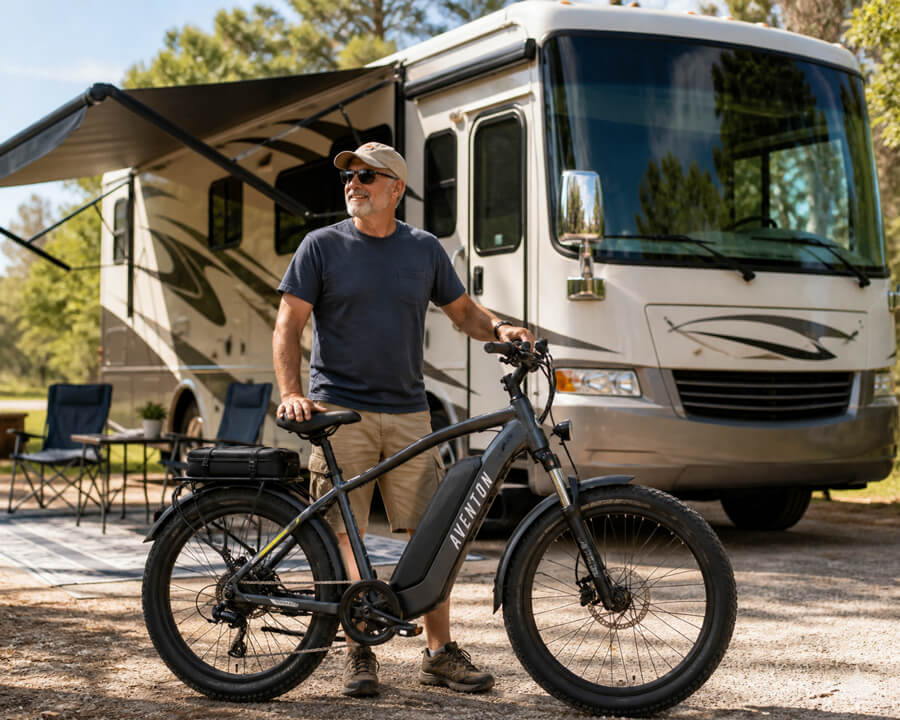
Electric bicycles have quickly become one of the most popular additions to the RV lifestyle. For many Workampers, they are no longer viewed as recreational toys, but practical tools that simplify daily life on the road.
Once an RV is leveled, connected and settled into a campsite, most people do not want to break camp simply to grab groceries, visit the campground office or explore a nearby town. E-bikes offer a convenient solution while also helping Workampers stay active and mobile.
Of course, e-bikes are not without downsides. They require secure storage, regular charging and a larger upfront investment than traditional bicycles. For RVers considering the purchase, the question becomes whether the convenience and flexibility justify the added cost.
Are Electric Bikes Worth the Cost for RVers?
There is no avoiding the initial sticker shock.
Although entry-level models are available for a few hundred dollars, many quality e-bikes suitable for RV travel range from $1,500 to $3,000 or more. Add heavy-duty bike racks, locks, covers, helmets and accessories, and before you know it, you’ve easily spent $5,000.
However, many RVers believe the convenience justifies the expense.
Compared to driving a truck or motorhome for every short trip, an e-bike costs very little to operate. Charging the battery costs pennies compared to filling a fuel tank. E-bikes also reduce wear and tear on tow vehicles and eliminate the frustration of maneuvering large vehicles through tight parking lots.
For some RVers with motorhomes, bringing e-bikes allows them to leave their tow vehicle at home, saving them from the added stress of hooking up and towing a vehicle.
Many Workampers consider their bikes to be one of the most-used tools they bring on the road.
I used an e-bike while Workamping nearly a decade ago, and it quickly became one of the easiest ways to explore parks and nearby areas without needing to drive everywhere. Riding trails instead of competing with vehicle traffic made the experience far more enjoyable. Keeping the battery charged and the bike secured added a bit of hassle to the routine, but I found the e-bike to be very beneficial for my RV lifestyle and the bikes and batteries have only gotten better since then.
Why E-Bikes Make Sense for the Workamping Lifestyle
Many Workampers stay parked in one location for weeks or months at a time. Once everything is connected and stabilized, disconnecting the RV for quick errands becomes very inconvenient.
An e-bike solves that problem.
Workampers commonly use e-bikes for trips to grocery stores, restaurants, laundromats, farmers markets and campground offices. Others use them to explore local trails, beaches and tourist areas where parking can be difficult or expensive.
E-bikes are especially useful in large campgrounds, state parks and resorts where employees may need to travel long distances throughout the property.
You may get great use out of your e-bike while on the job. A campground host can make rounds more efficiently. Maintenance workers can haul small tools using cargo e-bikes. Activity coordinators can move between buildings without constantly driving a truck or golf cart.
Some Workampers find that having an e-bike gives them flexibility to accept jobs others might avoid simply because transportation around the property is difficult.
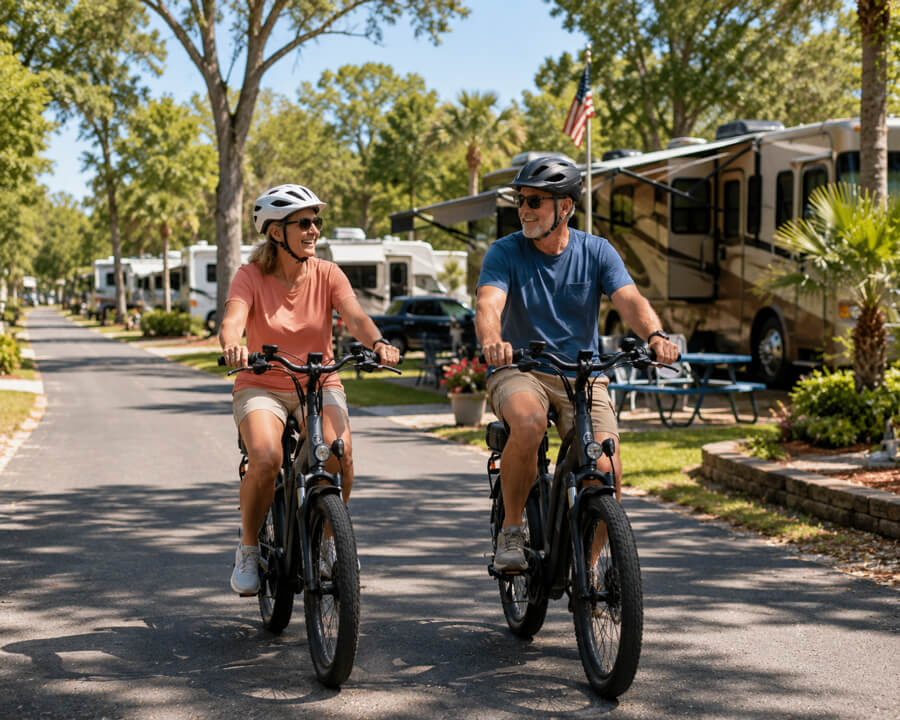
E-bikes also help many RVers remain active. Pedal-assist technology makes hills easier and allows riders with different fitness levels to comfortably ride together.
For older travelers or people recovering from injuries, e-bikes can make cycling enjoyable again rather than exhausting.
How Workampers Use E-Bikes Every Day
The practical uses for e-bikes continue to expand. Some Workampers use them for daily transportation inside large campgrounds. Others rely on them for errands in nearby towns or as an easy way to navigate around their workplace.
In tourist destinations, e-bikes often become the easiest way to navigate crowded streets and limited parking areas.
Using your truck or tow vehicle for long-distance errands while having the option to hop on your e-bike for local transportation is of great benefit. Some Workampers use cargo e-bikes to carry groceries, laundry or small equipment around the campground.
Many riders also appreciate the ability to access trails, narrow roads and campground pathways that are unavailable to larger vehicles.
Modern e-bikes typically offer ranges between 20 and 60 miles per charge, depending on terrain, rider weight and how much pedal assistance is used. For most campground errands and sightseeing trips, that range is more than sufficient.
Still, battery management becomes part of the routine. Longer rides require monitoring battery levels carefully, especially in hilly terrain or windy conditions.
Keep in mind that if the battery runs out before you return to the rig, e-bikes can still be used but you’ll have to do all the pedaling yourself, just like using a traditional bike.
Can an E-Bike Pay for Itself While Workamping?
For many Workampers, the answer is yes.
Although the upfront investment can feel substantial, e-bikes often reduce fuel expenses significantly over time. Using an e-bike instead of a truck for short daily trips saves fuel and reduces maintenance costs on tow vehicles. Those savings can offset much of the bike’s purchase price within a single season.
The financial benefits can extend beyond fuel savings. For example, an e-bike may allow some travelers to accept Workamping positions without towing a second vehicle. Others find that mobility gives them access to larger resorts, state parks or properties where transportation can otherwise become challenging.
For Workampers, the convenience alone can become valuable enough to justify the investment.
What to Look for in an E-Bike for RV Life
Not every e-bike is ideal for RV travel.
One of the biggest considerations is weight. Many e-bikes weigh between 50 and 70 pounds, making them much heavier than traditional bicycles.
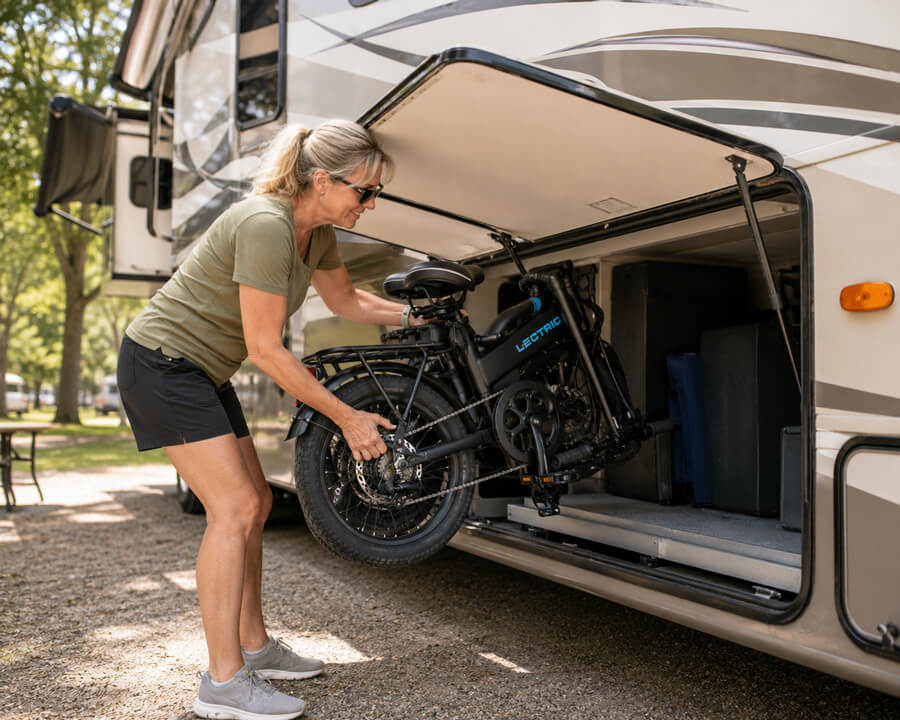
That weight affects storage, loading and transportation. You’ll need to be physically capable of lifting your bike up to put it on the rack or in an RV storage cabinet.
Standard bike racks are often not strong enough to support e-bikes, so many RVers purchase heavy-duty racks specifically designed for heavier bikes with wider tires.
Storage can also become challenging. Some owners use hitch-mounted racks or exterior storage compartments, but if those aren’t an option, do you have a place inside the RV where you can put them? Do you have a way to strap them down inside your RV on travel days?
Folding e-bikes have become increasingly popular because they fit more easily into RV storage bays or under beds and are a great option you may want to consider.
Security is another important consideration because e-bikes are attractive theft targets. You’ll want to use high-quality locks to secure e-bikes to fixed objects whenever possible. Some travelers also use alarms or GPS tracking devices to discourage theft.
Battery range, tire durability and cargo-carrying capacity might also be factors you’ll want to consider.
Is an E-Bike Right for Your Workamping Setup?
E-bikes are not perfect for every RVer. Still, many Workampers believe the pros far outweigh the cons.
For many Workampers, an e-bike becomes much more than a recreational toy. It can simplify everyday transportation, reduce dependence on large vehicles and make it easier to enjoy the places they visit.
As you explore future Workamping opportunities, think about how an e-bike might fit into your travel style, campground setup and day-to-day routine on the road.



Leave a Reply