
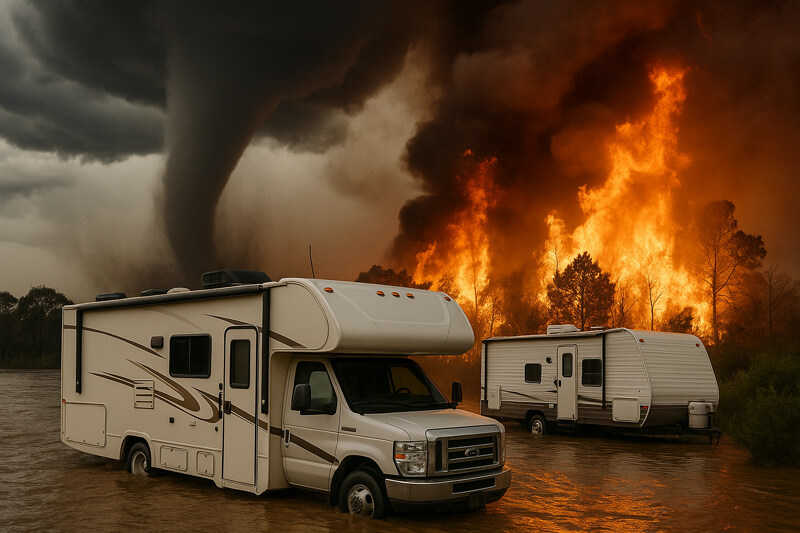
Emergencies can unfold without warning—whether you’re parked in a national forest, seaside resort, or small-town campground. Floods, wildfires, hurricanes, and even train derailments can force RVers to evacuate at a moment’s notice. The best way to stay safe is to prepare before disaster strikes.
This guide shares real-world lessons from experienced RVers and provides a checklist to help you build an emergency plan and “Go Bag” that could save lives.
Understanding the Risks
Every state faces some type of natural or man-made disaster. It could be a wildfire in California, a hurricane on the Gulf Coast, or a flash flood in Texas. Even events like chemical spills or tornadoes can develop so fast that RVers have only minutes to react.
Recent events remind us how quickly emergencies can escalate:
- California wildfires (2020–2023): Thousands of RVers had to flee campgrounds as fires spread through dry forests. Some lost their rigs entirely.
- Gulf Coast hurricanes (2020–2021): Storms like Laura, Delta, and Ida triggered mass evacuations. Many who delayed departure faced gridlocked roads and fuel shortages.
- Yellowstone flooding (2022): Heavy rainfall washed out roads and bridges, stranding visitors who had to be rescued by park rangers and some RVers had to leave their rigs behind.
- Ohio train derailment (2023): Toxic smoke from derailed railcars forced nearby residents and RVers to evacuate immediately.
- Florida tornado outbreak (2024): A sudden storm system spawned multiple tornadoes that damaged RV parks and injured campers, many of whom had only minutes to get to shelter.
Even smaller-scale events can be deadly. In 2010, flash floods in Arkansas swept through a campground, killing 20 people. In July 2014, two people were killed and nearly 40 more were injured when a small tornado ripped through a campground in Virginia. And as recently as July 2025, a flash flood created wall of water that destroyed entire campgrounds in Texas.
These tragedies all point to the same lesson: preparedness saves lives.
Lessons from Experienced RVers
John and Kathy Huggins, founders of Living the RV Dream, spent 13 years traveling the country full-time. They learned firsthand the importance of planning ahead.
In August 2004, the year before they started RVing full time, Hurricane Charley barreled through the Caribbean and appeared headed for Tampa, Fla. Then it turned abruptly and made landfall 100 miles further south near Punta Gorda around 8 a.m. It caught everyone off guard.
Kathy recalls Hurricane Charley in 2004:
“We had about 15 minutes warning and most people just weren’t ready. They had nothing packed and no important papers with them. Fortunately, we had our car packed and ready to go.”
Their experience inspired a checklist that every RVer can follow when checking into a new campground.
How to Build an RV Emergency Plan
When you arrive at a new destination, take a few minutes to plan for the unexpected. The Huggins recommend:
- Confirm your location: Ask which county the campground is in—weather alerts are issued by county, not city.
- Find the nearest storm shelter: Physically check the route. It might be an on-site building, such as a shower house, or an off-site community shelter.
- Use a weather radio: A battery-powered or hand-crank radio keeps you informed if power and cell service are out.
- Install an over-the-air antenna: Local TV signals often deliver faster, more accurate warnings than satellite or cable feeds.
Beyond that, your personalized plan should include:
- Communication: Identify a family contact outside the area who can coordinate updates if you’re separated.
- Evacuation routes: Know at least two ways out of every campground, and avoid interstates when possible.
- Meeting point: Designate a safe place to reunite if family members get separated.
- Local awareness: Note the nearest hospitals, urgent care centers, and veterinary clinics.
- Vehicle readiness: Keep your RV and tow vehicle at least half full of fuel—top off daily during high-risk weather seasons.
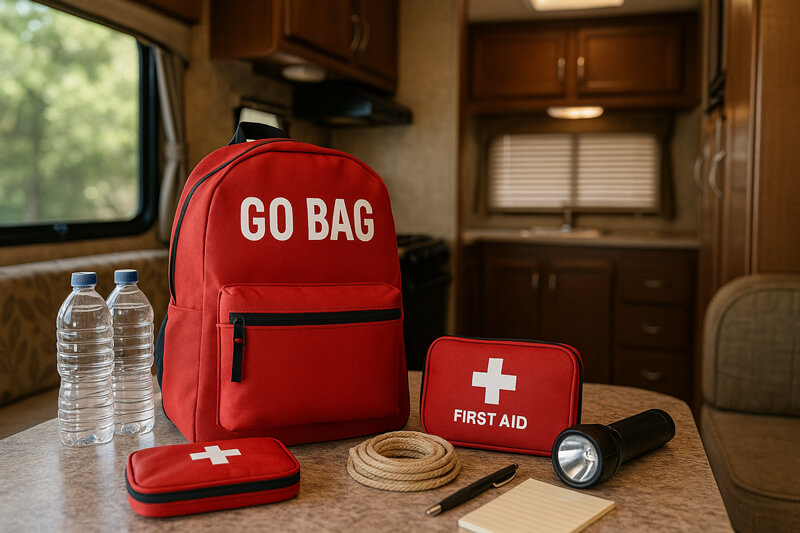
What to Pack in Your “Go Bag”
Having an emergency “Go Bag” ready can make the difference between chaos and calm. Keep it near your RV’s exit door for easy access.
Documents and Records
- Copies or photos of prescriptions
- Passports, driver’s licenses, and birth certificates
- Insurance policies (RV, auto, health, life)
- Banking and investment info
- Emergency contact info for family and key professionals like lawyers and accountants
- Pet vaccination records
- Photos of family members for identification
- Important business or financial documents
Technology
- Flash drive or encrypted device with document scans
- Laptop or tablet with chargers
- Phone with AC/DC chargers
- Portable power bank
Personal Items
- Toiletries and hygiene products
- A week’s worth of medications
- Spare eyeglasses or contacts
- Season-appropriate clothing and sturdy shoes
- First aid kit and flashlight
- Spare keys for RV and tow/towed
- Whistle or signaling device
Food and Essentials
- Bottled water and non-perishable snacks
- Pet food, leashes, and medications
- Entertainment for kids
- Hand sanitizer and wet wipes
- Cash in small bills (credit cards may not work if power is out)
Pro tip: Walmart and other retailers sell 1-terabyte USB drives for under $20—perfect for storing digital backups. For added safety, upload scans to secure cloud storage like Dropbox or OneDrive so you can access them from any device. Review your Go Bag every year to replace expired food or batteries.
Bottom Line: Stay Ready
Disasters don’t wait for convenience. Once an evacuation order is issued, roads clog fast and fuel disappears even faster. Preparation can make the difference between safety and tragedy.
As John Huggins wisely said:
“When the storm sirens are blaring, that’s the time to seek shelter, not to begin gathering belongings and important documents.”
Keep your Go Bag stocked, your RV fueled, and your escape routes planned. When you’re ready, you can face any storm with confidence.
For more RV safety advice, check out John and Kathy Huggins’ book, So You Want to Be an RVer? available on Amazon.



Leave a Reply