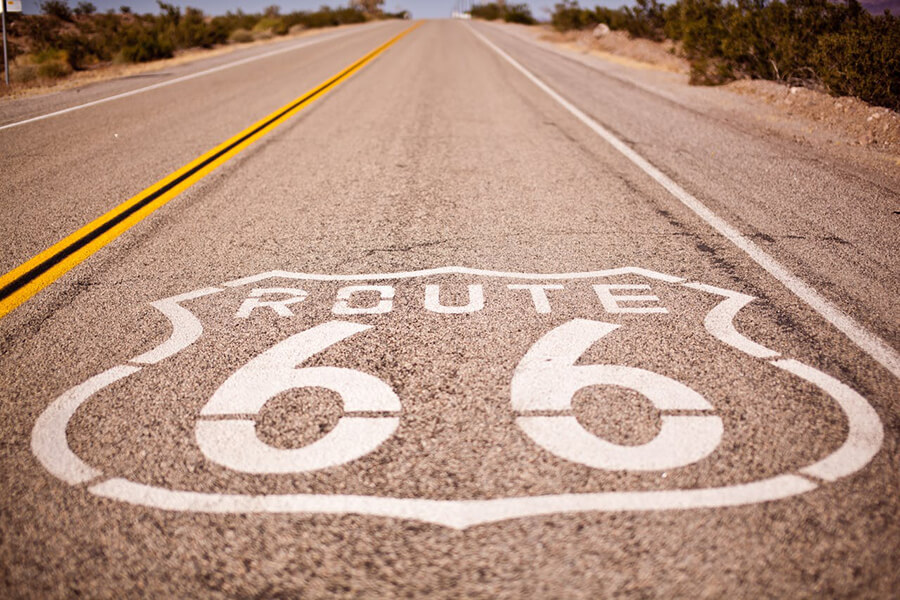
For Workampers who like to measure life in miles rather than months, Route 66 still holds a magnetic pull.
Stretching from Chicago to Santa Monica, Route 66 is more than a historic highway. It is a living corridor of small towns, stories, and opportunities – a place where curiosity is rewarded and the journey matters as much as the destination.
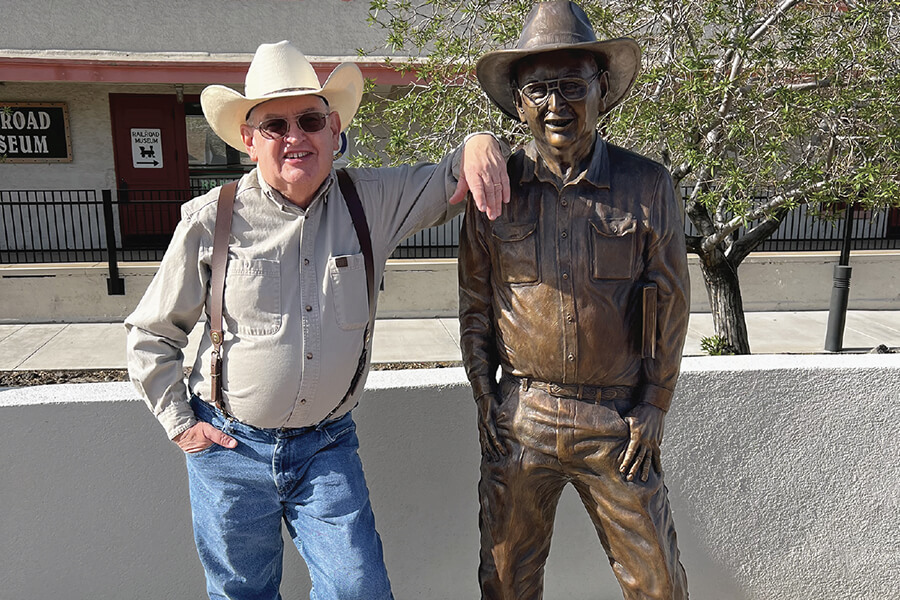
Few people understand that better than Jim Hinckley.
A Route 66 historian, author, speaker and travel storyteller, Jim has spent his lifetime exploring the “Mother Road” and all the communities connected to it.
While Route 66 officially disappeared from U.S. highway maps in 1985, Jim’s travels reveal a highway that never truly went away. Instead, it evolved into something larger than pavement.
“It’s a highway that doesn’t exist,” Jim said. “And yet it’s probably more popular today than at any point in its history.”
A Life Shaped by Route 66
Jim’s connection to Route 66 is not academic – it’s personal.
His first trip west came in 1959 when his family traveled from Norfolk, Virginia, and much of that journey was along Route 66. Then, in the summer of 1966, they moved from Michigan to Arizona by following much of Route 66.
Eventually, his family settled in Kingman, AZ, which remains Jim’s home today and the starting point of his travels.
That stretch of Route 66 in Kingman was part of his childhood. Jim learned to ride a bicycle on it and his first job was at an old Route 66 tourist stop. Jim’s experiences in ranching and his entire family life unfolded along the same corridor.
“Pretty much everything in my life has been tied to Route 66,” Jim said.
For Workampers, that kind of long-term relationship with a place resonates deeply. Route 66 doesn’t have to be a one-time bucket list trip. It can become a recurring destination – one that reveals something new with each season.
A Highway In Constant Motion
One of the most surprising things Jim teaches travelers is that Route 66 was never static.
From its creation in 1926, the highway was continuously rerouted, shortened, improved and adapted. New alignments replaced older ones and some segments were paved early, while others remained gravel or dirt roads for years. In many states, Route 66 shared pavement with earlier roads before becoming its own route.
“These changes were about traffic flow and safety,” Jim said. “The Route 66 of 1930 was not the Route 66 of 1960.”
For modern travelers, those multiple alignments are part of the appeal. Exploring Route 66 means discovering original roadbeds, abandoned bridges and forgotten towns that once thrived on highway traffic.
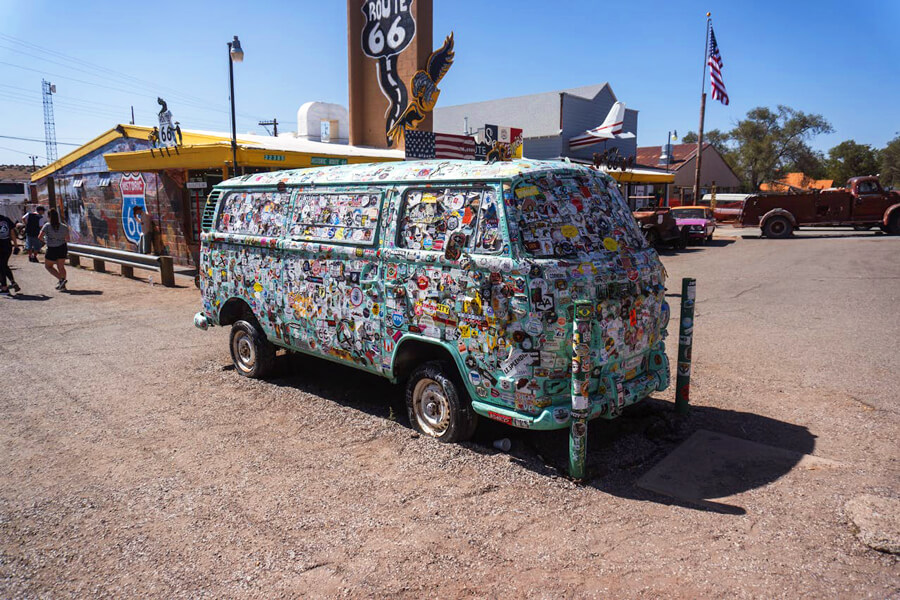
In fact, it is still possible to see iconic roadside attractions, like giant statues and larger-than-life animals, tepees, and still-working neon signs that once beckoned travelers to stop in the communities.
In places like Missouri’s Devil’s Elbow, New Mexico’s pre 1937 loop through Santa Fe, or Arizona’s Sitgreaves Pass, travelers can see the highway’s evolution firsthand.
Why Route 66 Resonates Worldwide
What continues to surprise Jim is how international the Route 66 community has become.
“There are Route 66 associations active in Japan, Germany, the Netherlands, the Czech Republic and Canada,” he said. “There are tour companies in Australia and New Zealand that specialize in Route 66.”
Jim has spoken at European Route 66 festivals attended by tens of thousands of people. He has met travelers rollerblading the entire route, walking on stilts end-to-end, and driving vintage vehicles thousands of miles.
For many international and American travelers, Route 66 represents freedom, open space and the idea of reinvention.
“One man from Eastern Europe told me that Route 66 symbolized freedom for his generation,” Jim recalled. “It’s the same way the Statue of Liberty symbolized freedom for earlier generations.”
That symbolism still resonates strongly with Workampers who value independence and the ability to travel at will.
Jim Hinckley’s America
Jim’s lifelong fascination with travel storytelling eventually became a platform.
Jim Hinckley’s America began appearing as newspaper and magazine columns in the early 1990s and grew into a travel network that today includes books, videos, a website, podcasts and social media channels.
Jim’s mission is to share America’s story and inspire travelers to take road trips.
His weekly “Coffee with Jim” show reflects that approach. Rather than focusing only on Route 66, the program features authors, historians, tourism leaders, preservationists and storytellers from across America.
Jim describes his show as a virtual diner where people gather to talk, laugh, exchange ideas and share travel tips.
The platform now reaches hundreds of thousands of people each month, many of them who are travelers planning upcoming trips or already living on the road.
Route 66 and Workamper Appeal
For Workampers, Route 66 offers more than nostalgia.
The highway passes through dozens of small towns where seasonal work, volunteer opportunities and short-term jobs are common. Museums, visitor centers, festivals and tourism offices often rely on Workampers who understand mobility and flexibility to inspire others or answer their questions.
Route 66 also encourages slower travel. Instead of racing from destination to destination, travelers are rewarded for stopping, exploring and engaging with local communities they encounter.
“Route 66 is America’s longest small town,” Jim said. “It’s a linear community.”
Tools for Traveling Route 66 Today
Although Route 66 no longer appears on standard highway maps, traveling it today is easier than ever.
Jim recommends two primary resources. The first is the Route 66 Navigation App, which helps travelers follow historic alignments and avoid dead ends. The second is the “EZ66 Guide” by Jerry McClanahan, which is a hand-illustrated guidebook filled with maps, notes and trivia.
“These two tools complement each other perfectly,” Jim said.
State Route 66 associations, especially in Oklahoma, also provide detailed visitor guides and responsive assistance. Jim’s own website, jimhinckleysamerica.com, offers travel articles, restaurant reviews and historical context.
Why Route 66 Still Matters
Route 66 was never the most scenic or the most historic highway in America. What made it different was promotion, storytelling and timing.
From early tourism campaigns to songs, movies, television shows and novels, Route 66 became woven into American culture. It introduced novelty marketing, roadside attractions and the idea that travel itself could be entertainment.
That legacy continues today.
“It’s still the road of dreams and the road of colorful characters,” Jim explained. “It started as a highway, but, somehow, it became so much more.”
For Workampers, Route 66 remains an invitation to slow down, explore back roads and to connect with people whose stories are rooted in place. For those who value freedom, flexibility, and community, Route 66 is still very much alive.
And for some – like Jim Hinckley – the adventure truly never ends.
For more information, people can connect with Jim at jimhinckleysamerica.com or find his Coffee With Jim podcast on iTunes, Spotify and other distribution sites.
To hear Jim tell his story in his own words, check out Episode 351 of The Workamper Show.
Workampers who want access to the newest listings – including short-term and small-town opportunities along Route 66 – can explore current openings at Workamper.com’s Job Listings page.



Leave a Reply